
Shopee Algorithm Updates 2026 for Sellers: What Shopee Actually Published
Shopee has not published a 2026 organic ranking formula. Seller Education, Shopee Ads, and a Shopee search paper do confirm how listings get filtered, how ads are ranked, and which reports changed this year. Those sources disagree with blog posts that assign percentages to click-through rate, conversion, or reviews.
If you sell on Shopee in the Philippines, Malaysia, or Singapore, use the rules below for the site you actually operate. A Singapore fulfilment rule is not a Malaysia live rule. An ads setting is not an organic rank weight.
Search ranking predicts behaviour, not keyword count
Shopee’s search team described its pre-rank system in Residual Multi-Task Learner for Applied Ranking, published at KDD 2024 (arXiv:2411.09705). The paper says large search systems narrow items in stages: match, then pre-rank, then rank. Pre-rank has to scan a very large set quickly and keep items that fit the shopper’s interests and the search keywords. ResFlow, the model in the paper, is fully deployed in Shopee Search pre-rank. It learns related actions together. The paper’s examples are click, add-to-cart, and order. In a live test, order per user rose 1.29% versus the previous model, with no extra latency.
That 1.29% is a model test result. It is not a lift you can claim by editing a title. The paper also covers only pre-rank. A later rank stage still orders the shortlist.
What sellers can take from it:
- A title is there to match the query. Repeating a keyword does not decide the rank.
- The model is built to estimate whether a shopper will click, add to cart, and order.
- Results can differ by shopper, because pre-rank keeps items aligned with that shopper’s interests and the query. One account, on one device, is not every buyer’s page.
Shopee has not published the weight of each signal.
Keywords still decide relevance
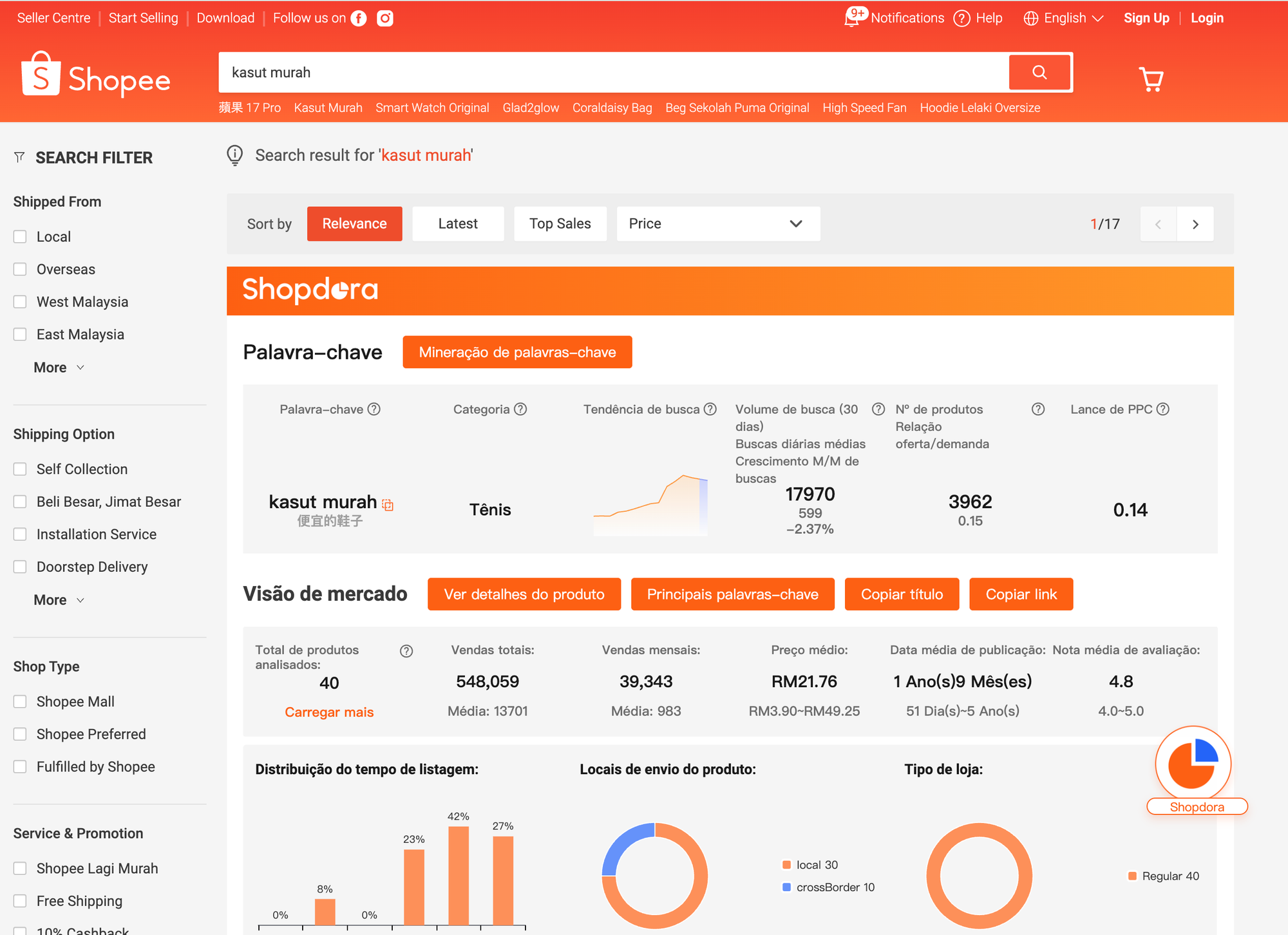
Malaysia Seller Education, updated 5 February 2026, still defines SEO as making the shop easier to find in Shopee search. The method is short: find words buyers type, then put those words in shop and product information. The guide points sellers to suggested keywords in the Shopee search bar (About search engine optimisation).
Taiwan’s Shopee University gives beginners this title pattern (Shopee University SEO article):
product name + feature + related keyword + use + spec or model
It also says the pattern is a starting point, and that different products need different titles. It tells sellers to read search suggestions before writing.
Singapore’s listing rules, dated 6 July 2026, are stricter than “add more keywords” (Best practices for listing optimisation):
- Title length at least 10 characters
- No excessive or irrelevant search terms
- No exaggerated claims (“the only one”, “guaranteed by experts”)
- Title includes the brand or a clear product type
- Description at least 60 characters, or at least one description image
- Enough distinct images, fitted, clear, clean background, no watermark over the product
The same update says a new listing needs a video to reach the Excellent level (View performance and optimise your listings tasks).
Items published more than 90 days ago are treated as old listings and checked for six extra gaps: brand, key attribute, fewer than three attributes, size chart, non-standard variations, and wrong category. That is a content check. Shopee does not say “no edit for 90 days means a rank penalty”.
Wrong category is called out because the right category helps the product appear in relevant search results. Keyword spam is still prohibited. Singapore defines spam as repeating the same word, a near-spelling, or the same emoji more than three times, or putting unrelated terms in the title (What is keyword spam?). Minor listing violations, including brand-name spam and poor information, are deboosted until fixed. The lower rank can take up to a day to show, and up to a day to recover (Listing violations).
Shopee Ads Malaysia says the same thing from the ads side: irrelevant or inaccurate words in the title can lower search listing visibility. Complete, accurate attributes can raise it (Improve your product detail page).
A practical title is readable, names the product, and uses words shoppers search. It does not chase keyword density.
Ads ranking is a separate system
Several “algorithm” claims online are ads settings. They change who gets a paid slot. They do not publish the organic formula.
Which products Shopee Ads suggests. The product selector looks for listings with high sales potential when advertised. Tags, where shown, are:
- Best Selling: strong sellers in the category
- Good ROAS: organic sales look healthy relative to typical ad cost in that category
- Top Searched: tied to popular search terms, so ads may get more impressions
Source: Advertising the right products. Those three tags are shown to selected sellers. Other sellers see a thumbs-up on recommended products. These tags are for choosing what to advertise.
Broad match is personalised ad matching. For Product Search Ads, Broad Match can show the ad on related searches, not only the exact keyword. Shopee says that match may use historical search behaviour across the platform and that shopper’s own search history (How to create Product Search Ads). That sentence is about when an ad is eligible. It is not a statement that two people searching the same word see the same organic order.
Bid price does not buy the top spot by itself. Shopee’s newer suggested bid aims to place an ad among the top 20% of ads for that keyword, with impressions and ROI in mind. The older suggestion pushed ads to the top of search and was often too expensive. If ad quality score is low, the actual rank can be worse than the suggestion (How to use Ads). Shopee’s help page does not date this change to 2026, so treat it as current ads guidance, not as a 2026 organic update.
Singapore’s ads guide names the two inputs to ad rank: bid price, and quality score. Quality score includes keyword relevance, expected click-through rate, expected conversion rate, photos, title, reviews, ratings, sold count, price, and promotions (Using Product Ads). A higher bid or a higher quality score can improve ad position. Both act at the same time. Shopee has not published a formula such as “bid times quality”.
The 2026 reporting change: GMV became Sales
This one is a dated 2026 change, and it is about numbers, not rank.
From January 2026, Shopee Ads renamed GMV to Sales. The new Sales figure excludes seller rebates. Historical GMV is left as it was. Figures from January 2026 onward use the new definition, so a 2025-versus-2026 comparison can look like a drop when the definition changed.
Shopee says the same Sales definition is used in:
- Shopee Ads
- Business Insights
- Brand Portal
- Marketing Center
- Seller Center (My Income, My Orders, Reports)
Source: The GMV metric will be renamed to Sales, first published 19 December 2025. Malaysia and Philippines Seller Education add that GMV disappeared from Shopee Ads on 16 January 2026 (Why my sales data fluctuates).
Two limits matter. Sales still includes cancelled and returned or refunded orders. It is the order value after seller rebates, not a cleaned “completed orders only” number. Ad attribution itself did not change in that announcement.
Malaysia Live and Video: Creator Level from 1 September 2026
Shopee Malaysia launched Creator Level on 1 September 2026 for Shopee Live and Shopee Video (Creator Level Program). It is a Malaysia creator programme. It is not a search-rank formula for every Shopee market.
Level is based on the past 30 days, using both activity numbers and content quality. The published activity measures include:
- Active days: a live of at least 30 minutes, or a video of at least 30 seconds
- Content ADO: average daily orders from content
- Influence Score: the share of content orders that come from Discovery, rather than from shoppers who already had a path to the product
Shopee’s own improvement list is: post original, high-quality content; stay active; raise Influence Score; drive orders and sales; follow community guidelines. Higher-quality content is described as increasing reach, conversions, and Influence Score. Affiliates need an Influence Score of at least 20% as part of the quantitative bar for Level 2 (Discovery vs conversion orders).
Singapore operations that changed in 2026
These policies affect whether a shop can keep selling and how buyers experience delivery. Shopee links them to trust and conversion. It does not assign them a search-rank percentage.
From 10 March 2026, the weekly late-shipment penalty line for local Singapore sellers moved from 10% to 5%, with a grace period from 10 to 24 March 2026 (Platform fulfilment updates, March 2026).
From 14 September 2026, pre-order listings are capped at 10% of active listings, including Mall and Preferred sellers. The previous cap cited in that notice was 20%. Shops over the cap are limited to 100 active listings for 7 days (2026 platform updates, August 2026). An earlier 2026 Singapore note used a different pre-order percentage. For a Singapore shop, follow the 14 September rule.
What to do when a rank moves
Seller Center shows your own traffic, conversion, and the Smart Diagnosis tags on My Products: new opportunity, top sales, top sales fading, high conversion with low traffic, and high traffic with low conversion (Updates to the My Product page). It does not show a competitor’s rank on a keyword, and it does not show how often shoppers search that keyword.
Because pre-rank uses both the query and the shopper, a single search on your own phone is a sample. Check the same keyword more than once, and read search volume before you decide the word is worth a title change or an ad bid.
Shopdora is built for that check:
- Install the Shopdora Chrome plugin and open Shopee search on the site you sell on, such as shopee.ph, shopee.com.my, or shopee.sg.
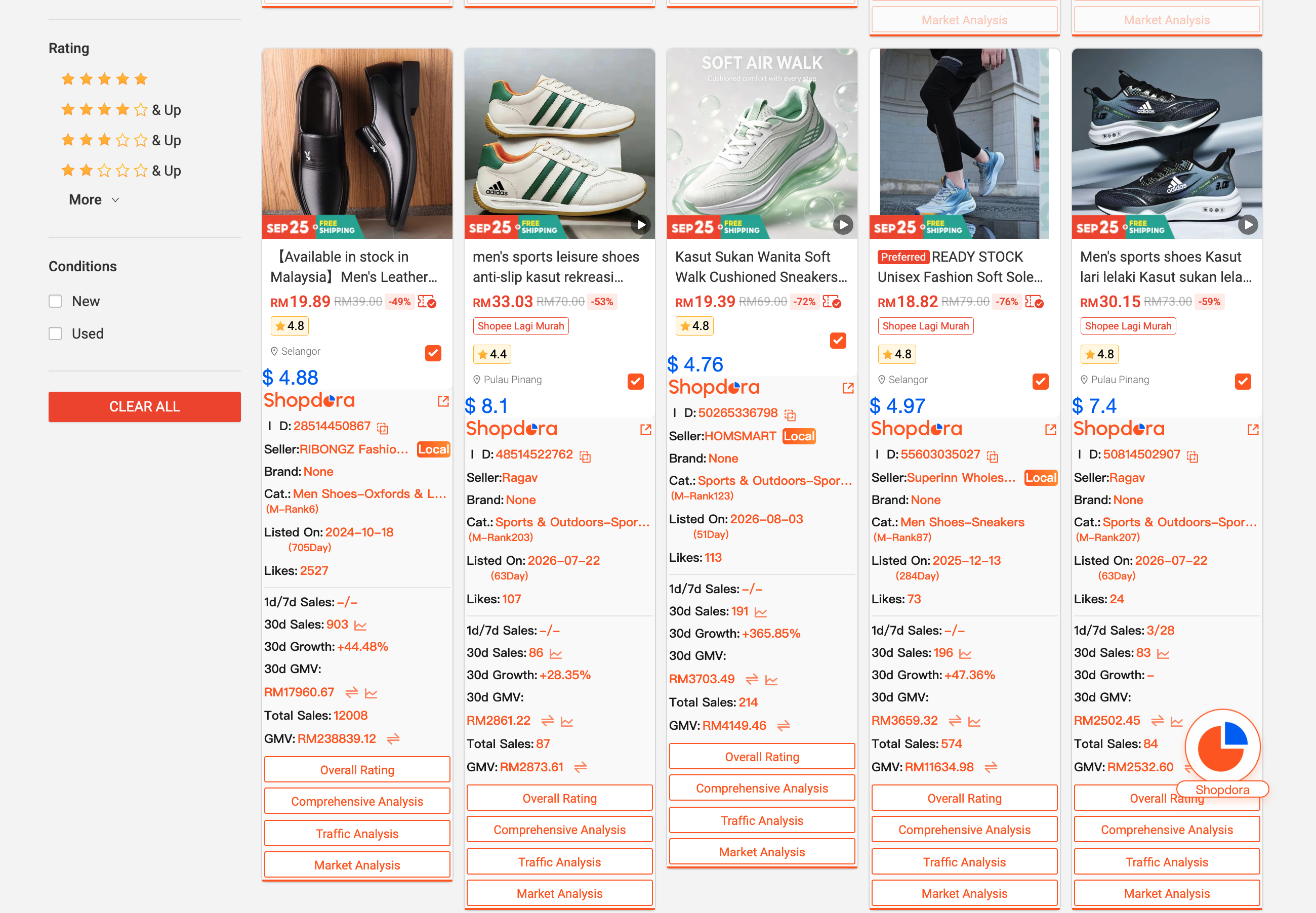
- Observe where a product sits for that keyword, then download the ranking data instead of keeping a screenshot.
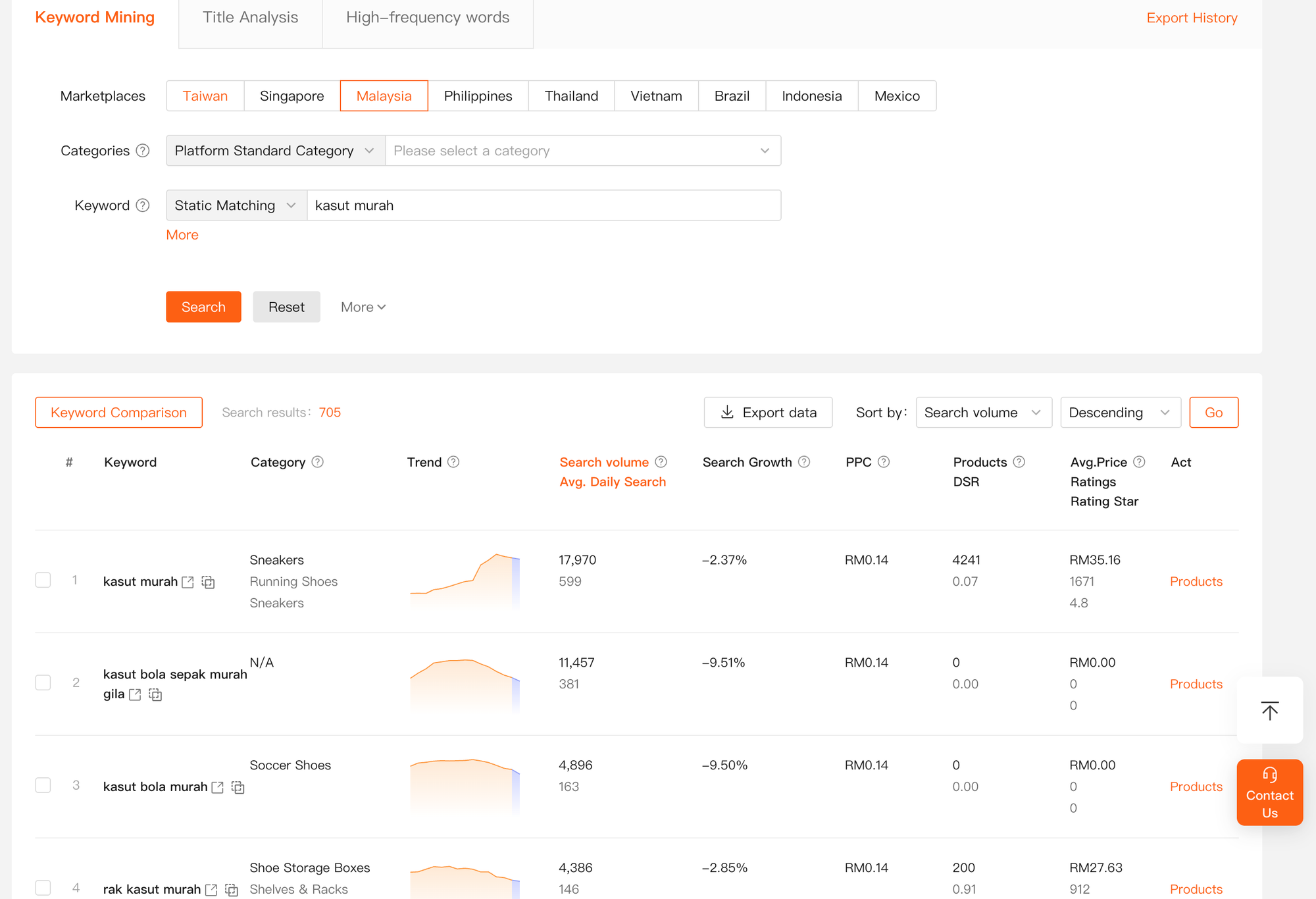
- Look up the keyword’s search volume before you treat a rank change as a crisis or an opportunity.
Use the two numbers together. Search volume tells you whether shoppers ask for that word. Rank data tells you whether the listing showed up in the results you checked. A high-volume word where you never appear is a relevance problem: title, category, and attributes. A word you rank for, with thin search volume, will not feed the shop by itself. A rank that jumps around is a reason to keep downloading checks, not a reason to invent a weight for click-through rate.
Related reading: Shopee analytics tools for PH, MY, and SG and Shopee price tracker.
FAQ
Did Shopee publish a 2026 ranking formula?
No. Shopee published listing-quality rules, ads settings, a Sales definition change, and market-specific programmes. It did not publish organic ranking weights. Posts that list CTR at 20% or conversion at 30% are not from Shopee.
Does keyword stuffing still help on Shopee?
No. Singapore Seller Education still deboosts titles with repeated or unrelated keywords. Accurate titles, categories, and attributes are what the official guides tell sellers to fix.
Why did Sales look lower in 2026?
From January 2026, GMV was renamed Sales and seller rebates were removed from the number. History before that date still uses the old GMV definition. The new Sales figure also still includes cancelled and returned orders.
Can one search show my real Shopee rank?
It shows the rank for that check. Shopee’s pre-rank paper says the shortlist depends on the query and the shopper. Use the Shopdora plugin to record the rank and download it, then compare it with the keyword’s search volume. Repeat the check instead of treating one screenshot as every buyer’s page.