
Shopee Analytics Breakdown: Vietnam's Stress-Toy Boom (+40%) and Who's Actually Eating the Volume

Stress toys on Shopee Vietnam — think slime, squishies, the squeeze-and-press stuff — are still climbing in monthly sales over the last 30 days, and brand concentration is low enough to basically ignore. Plenty of cross-border sellers see "no brand moat" and read it as open land. But demand still running and the door not being locked by any brand doesn't mean you get volume just by walking in. This piece lays the whole competitive picture out, and a bit of Shopee analytics makes it clear who's eating the volume and where you can actually get in. Pull the Shopee data before you commit, not after.
First, know what kind of category this is
Slime and squeeze toys sit under Mom & Baby – Toys on Shopee Vietnam. It's a purely non-standardized category with no hard specs, riding on shape, feel, color, IP collabs, and a little novelty. Unlike phone cases, where you copy the spec sheet and ship, here the design itself is the moat. But it's a shallow moat: a hit shape shows up and gets cloned to saturation within two weeks. Before deciding whether to enter, see this clearly. This category competes on launch speed and content, not technology.
Demand is real, and still growing
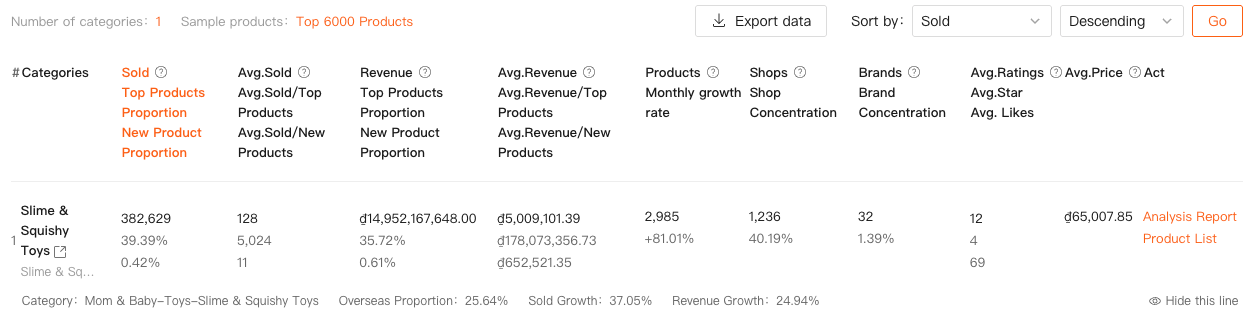
According to Shopdora data, stress toys on Shopee Vietnam did 380,000+ units in monthly sales over the last 30 days, with a monthly sales growth rate of 40.31%, 2,900+ products, and an average price of 64,767₫. Demand is solid and still trending up. But one number needs to be read alongside it: product growth is 76.04%, so supply is pouring in faster than demand is rising. The pie is genuinely getting bigger, but the people crowding in are multiplying faster than the pie, so competition only gets tighter.
The brand side is almost empty
Look at brands first. There are 31 brands, and brand concentration is just 1.39%. The top few (TAKACOL, Sankid, Taiwan Collection, Lavish, Fidget Cube) each move only a few hundred units a month, and most are cross-category generics. Not one has built real scale inside this niche.
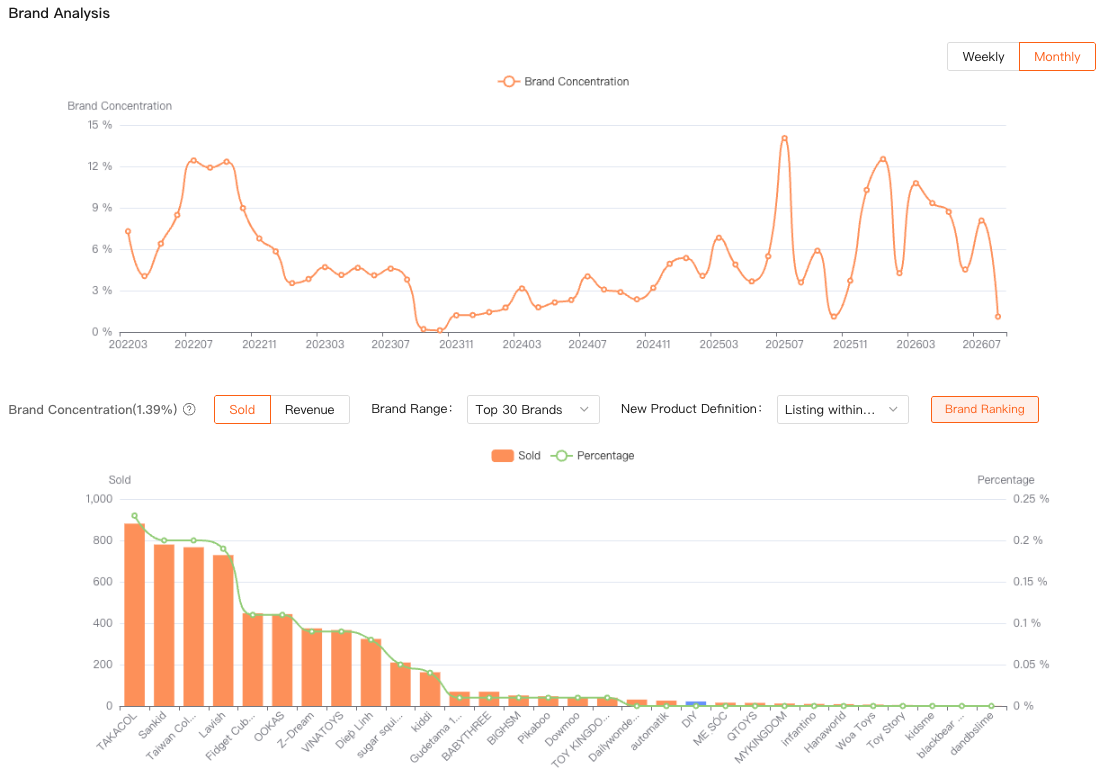
What does 1.39% mean in practice? There's almost no brand awareness in this category. Buyers don't shop by label. They buy on shape, price, and whose livestream looks good. For a cross-border seller with no brand, that's supposed to be great news: the door isn't locked by any brand. But that's exactly where the problem sits. If the door's unlocked, who took the volume?
The volume actually went to local shops
The answer is in the shop rankings. Pull the top shops and the volume-eaters are all Vietnamese local stores, not brands and not cross-border sellers: buybox208 at 67,000+ monthly sales across 70 products; dandbslimey at 20,000+ with just 23 products; Store Đào Nhi at 12,284 sales and 20,387 followers; Duashop at 11,808 sales and 284,245 followers; Gudetama Shop at 8,805 sales and 63,867 followers.
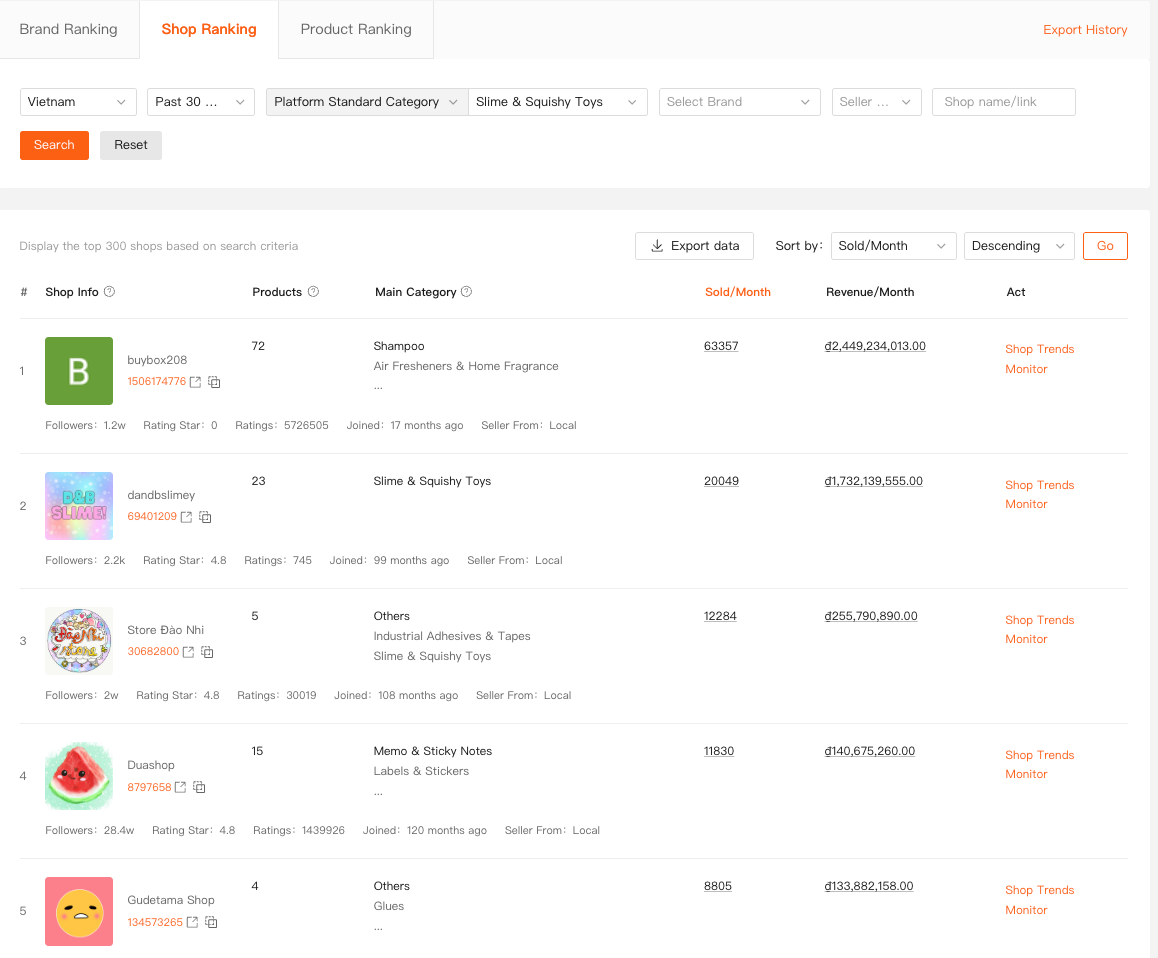
See the pattern? These shops don't run on a brand. They run on "store + constant new launches + followers and content." Some push volume with dozens or hundreds of listings; some ride hundreds of thousands of followers into repeat buys. The real moat in this category isn't the brand, it's local shops' launch cadence and content muscle. Who eats the volume? These local stores do.
Now look at the new-product sales share: 0.39%. Freshly listed products barely get any volume. What sells is the aged listings local shops have grinded out, stacked with reviews and followers. Top-shop sales share is 40.3%, not welded shut, but paired with a 0.39% new-product share, it tells you this is a category you have to grind and keep feeding, not one where a bare launch pays off.
Why the traffic sits with local shops
You have to spell out where the traffic comes from, otherwise "local shops eat the volume" is just a conclusion. Two things stack here.
One, Vietnamese e-commerce is heavily social by nature. Multiple market reports point out that Vietnam's social commerce is led by Shopee Live and TikTok Shop, with sales leaning hard on livestreams and short video rather than pure search-shelf browsing. Two, stress toys are, by their nature, high-engagement short-video material. Squeezing, pressing, stretching, the whole de-stress motion just films well. Worldwide, this kind of toy basically gets its lift from short video.

Stack those two and the local shops' edge is obvious: they're closer to local content and livestreams, they can make content in Vietnamese, run local streams, and keep up with the local rhythm. Volume flows toward content and livestreams, and local shops happen to sit right at that entrance. That's not something a cross-border seller catches up to by throwing money at search.
The big keywords are saturated — the gap is in the long tail
This is where Shopee data analytics earns its keep. Pull the keywords and it's even clearer. The head term *squishy* has 300,000+ searches, a supply-demand ratio of 189.49%, and 5,141 products selling against it; *slime* has 110,000+ searches with a ratio as high as 368.08%. The higher the supply-demand ratio, the more listings sit behind a single search, and the more likely your new listing drowns. These two head terms are already saturated — pushing into them head-on just props up the top local shops.
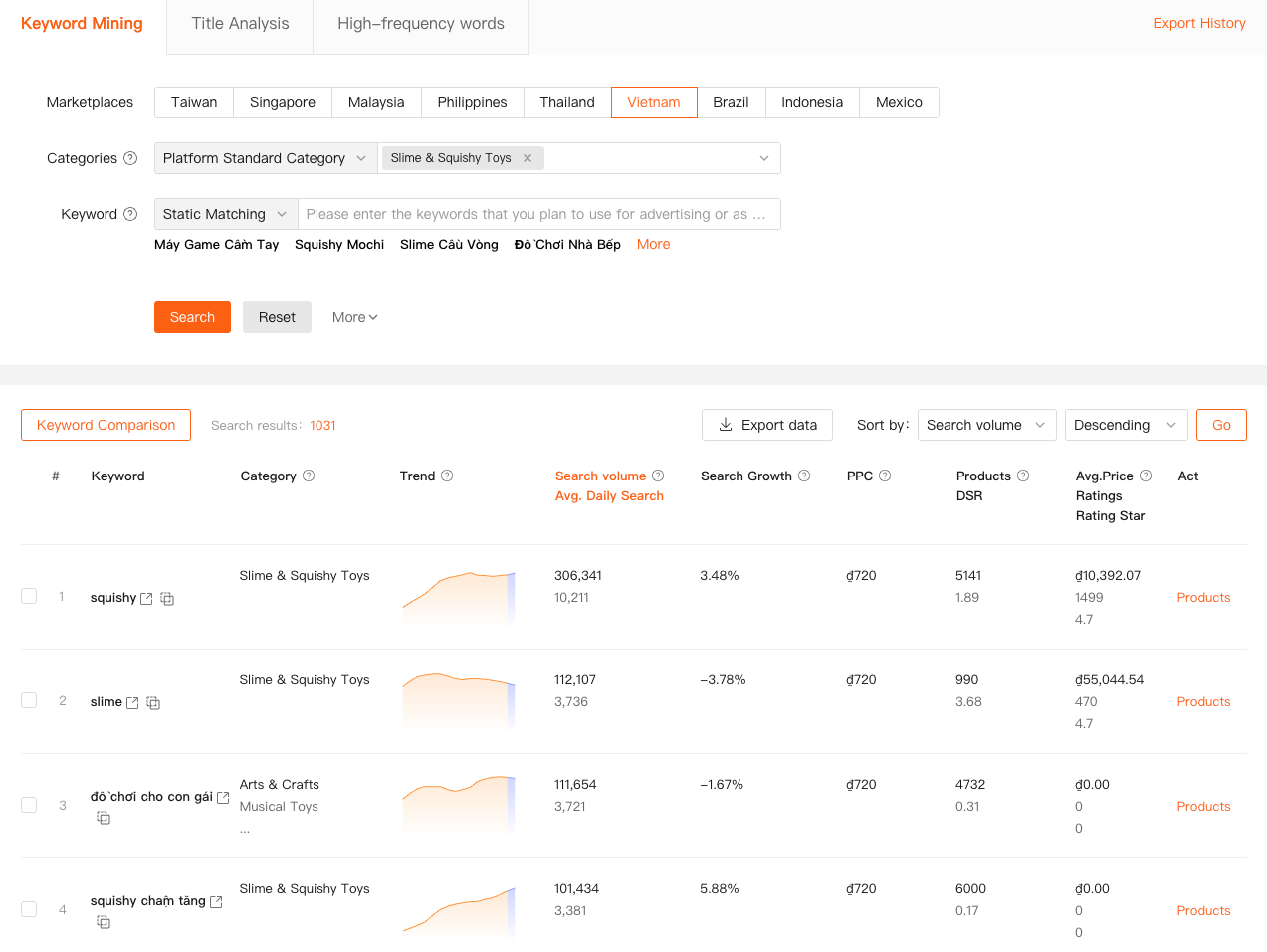
But there are gaps in the long tail. *squishy phô mai* (cheese shape) has a supply-demand ratio of just 15.49%; niche shape terms like *squishy bánh* (pastry shape) and *đồ chơi silicon* (silicone toy) show clearly lower ratios — people are searching, but not many are selling yet. That's where a cross-border seller can cut in: skip the head terms, use niche shapes and IP designs to lodge in the long tail. Also watch out — terms like "đồ 1k" and "squishy giá rẻ 1k" (1,000-dong ultra-cheap) show up in bulk, meaning the price anchor here is pressed extremely low, and following it down into a price war is a dead end.
Don't wade into the bloodiest price band
Category average price is 64,767₫, but the keyword side is full of 1w (10,000-dong) ultra-cheap intent. Volume really does concentrate in the low band. But that band is welded shut by local shops running on volume and low-cost supply chains, and a cross-border seller's logistics and cost structure simply can't compete there.
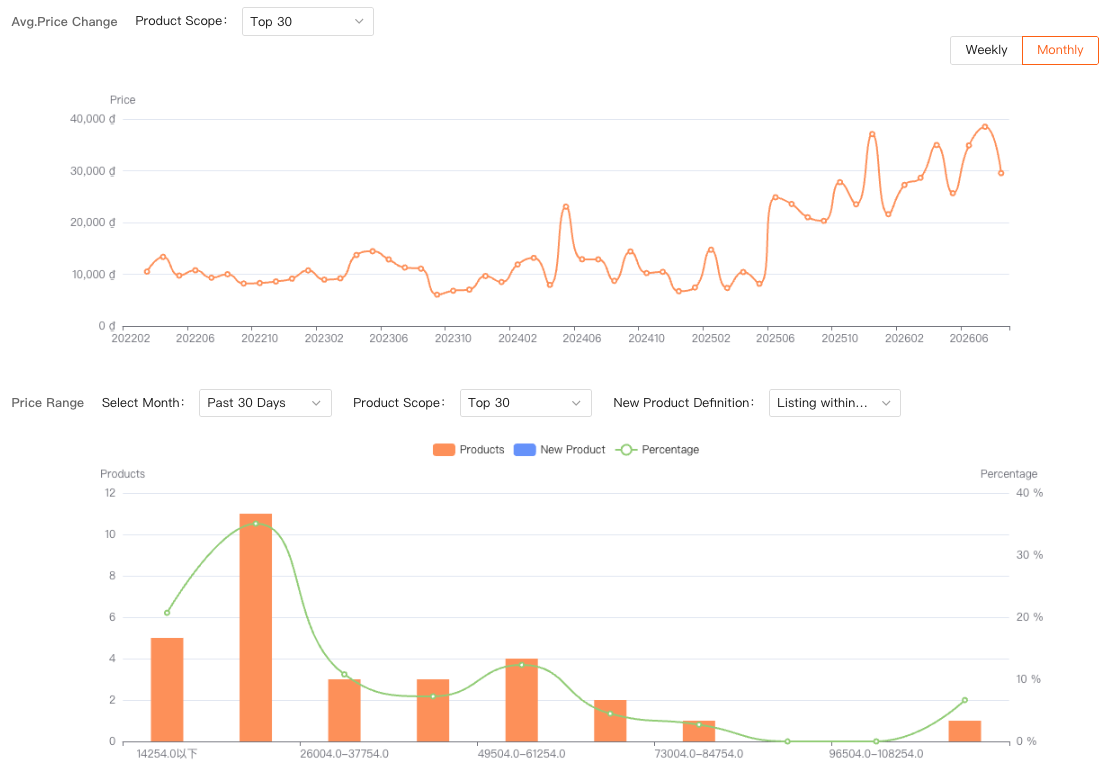
Cross-border sellers hold 25.64%, roughly one in four sales, which says cross-border can genuinely move product here; local shops haven't sealed the pie shut. But you have to pick your spot. The lowest price band is local-shop turf fought on volume; squeezing in there rarely wins. The mid band, where you build a premium on differentiated shapes, IP collabs, and gift-box sets, has far more room. Moving up in this category is a more real opportunity than racing to the bottom.
So how do you actually get in
Put the four threads together: demand is real and growing, brands hold no moat, cross-border sellers can get volume — the direction holds up. But volume goes to local shops on launches and content, new products barely get any, and the low band is welded shut. So this is not a category where charging in gets you volume.
The move differs by seller. If you want bare launches paying off in a month, this category is a hard pass, and the 0.39% new-product share is your answer. Small teams and boutique sellers with a supply chain that can iterate designs fast have their opening in niche shapes and IP designs: dodge head terms like *squishy* and *slime*, lodge in low-ratio long-tails like *squishy phô mai*, push price toward the mid band, and build a premium on design and content instead of wading into the 1k price war.

The ones who really thrive are teams with content and livestream muscle. Volume in this category follows content to begin with, and sellers who can make short video and work with local creators are the ones who keep up with the local shops' cadence. One more reminder: stress toys are trend toys, and trends have cycles. This wave got lifted by short video and livestreams, and when the heat fades it pulls back. Treat it as an opportunity that needs constant feeding and a content rhythm — not a stable long-term earner you can sit on.
Wrapping up
Vietnam stress toys are a category with real, still-growing demand: 380,000+ monthly units, up 40%, brand concentration at just 1.39%, and the door genuinely not locked by any brand. But this wave already has takers: local shops have eaten the bulk on constant launches and livestream content, and new-product sales share is only 0.39%. The spot cross-border sellers can actually hold is mid-band niche shapes and IP designs; fighting local shops on volume in the low band isn't worth much, and cutting in gradually on design iteration and content is the more real play. Get honest about whether you have the launch and content chops before deciding to ride this one. Open Shopdora and use it as your Shopee product research tool — the kind of Shopee analytics that turns a category like this from a guess into a plan.