
Shopee Keywords: How I Understand Market Structure and Traffic for Non-Standard Products
Hi, I’m David. I’ve been running my own Shopee stores for a little over three years now, mostly in non-standard product categories. I don’t write theory for the sake of theory. Everything below comes from real trial and error—products that failed, keywords that never converted, and traffic that looked promising but went nowhere.
With the holidays coming up, I finally slowed down enough to manage some thoughts I’ve shared countless times in private chats with newer Shopee sellers. What I’ve noticed is this: many beginners work extremely hard, but their understanding of market structure and Shopee keywords is still very fuzzy. They optimize listings, run ads, and tweak prices—but without a clear map of where the traffic actually comes from.
This article is my attempt to explain how I personally think about market cognition and traffic organization for non-standard products on Shopee, using keyword data as the foundation. These insights are based on Southeast Asia Shopee markets, and they may not apply perfectly to highly standardized products. Still, if you sell non-standard items, this framework will save you months of confusion.

Market Cognition Comes Before Any Promotion
Before talking about Shopee keywords, ads, or optimization, we need to clarify one thing: promotion without market cognition is just gambling.
A “market,” in my definition, is not a category name. It’s the sum of traffic generated by a group of closely related keywords that share the same buying intent. For example, a product like a “black storage shelf” doesn’t live under one keyword. On Shopee, buyers may search for it using dozens of variations—material, color, room usage, size, or function. All of these variations together form a single traffic market.
What’s important is that traffic within the same market is connected. When one keyword starts ranking organically, it often lifts other related keywords along with it. This is why sellers sometimes see traffic growth even when they only optimized one part of the title—it’s not magic, it’s market linkage.
In every Shopee category, there are multiple markets. The largest one is usually the “head market,” built around broad, attribute-free keywords. Smaller markets are formed by more specific attributes, use cases, or styles. A competent seller should know how much traffic each market represents, which ones convert better, and which ones are realistically accessible for their current product and store level.
This big-picture understanding determines where you should compete first. Without it, optimization becomes random work.

Evaluating Competition Without Click or Conversion Data
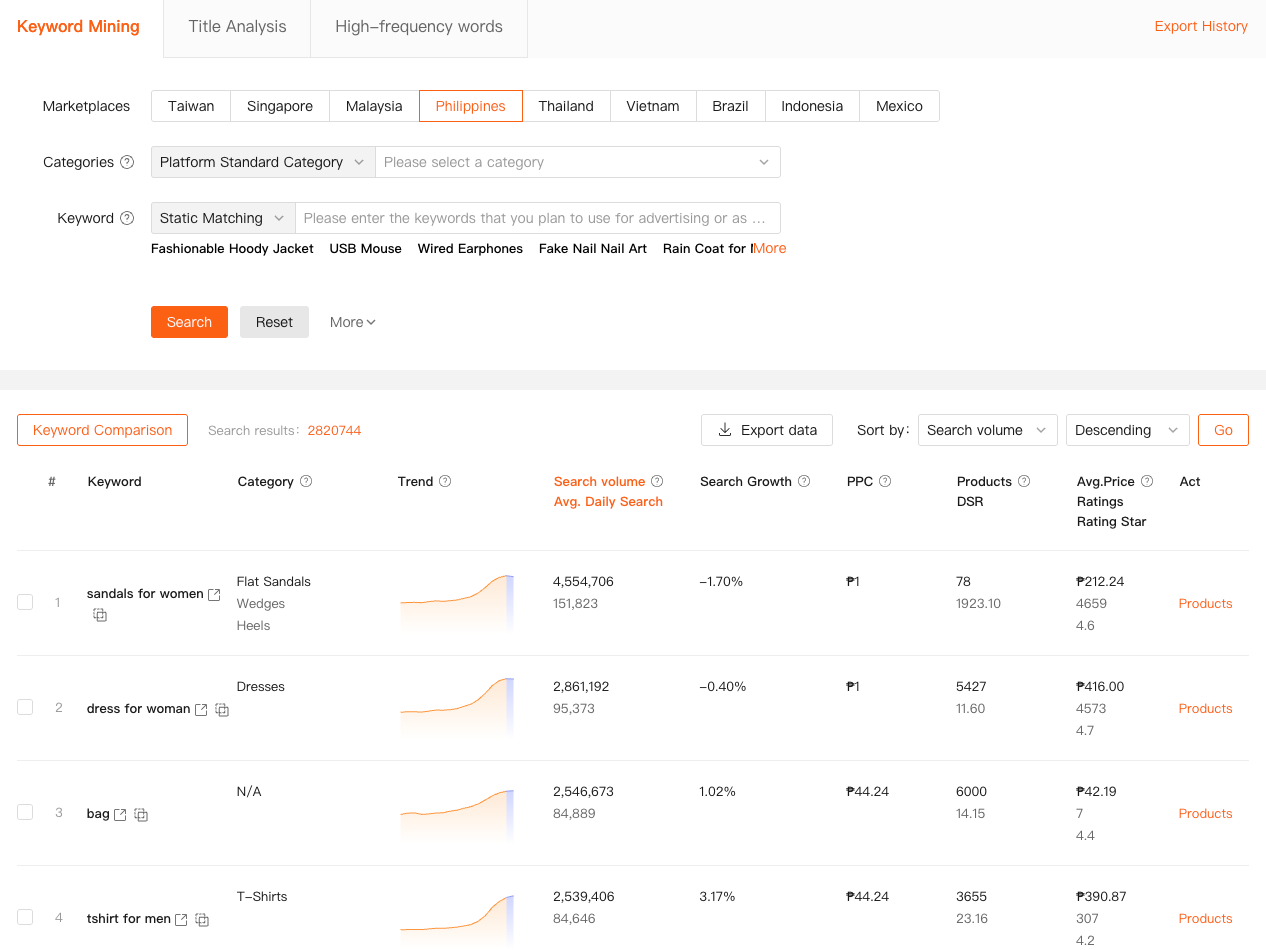
I assess competition using a combination of related product count (DSR) and PPC reference pricing, both of which are available in Shopdora’s Keyword Mining data.
A keyword market with a high number of competing products and rising PPC usually signals heavy advertiser participation. That doesn’t mean it’s impossible—but it does mean you’ll need stronger pricing, visuals, or differentiation to survive.
On the other hand, I often find mid-volume markets where product counts are reasonable and PPC is stable. These are usually where non-branded sellers can gain traction without burning budget.
I also look at average price and rating volume within each keyword market. This gives me a sense of whether the market is dominated by mature sellers or still fragmented. Markets with healthy pricing but relatively low rating accumulation often indicate room for newer listings to grow.
Turning Keyword Markets Into a Traffic Strategy
Once the traffic markets are mapped, everything becomes clearer.
Instead of trying to rank for everything at once, I assign priority levels to different markets. High-volume, high-competition markets are usually long-term goals. Medium-sized, attribute-driven markets often become my entry point, where I can build initial traffic signals and reviews.
This approach directly influences how I write titles, structure descriptions, and plan ad coverage. Each listing isn’t optimized for “more keywords,” but for specific traffic markets with clear intent.
This is where Shopee keywords stop being abstract data and start becoming a real operating framework.
From Market Analysis to Practical Listing Decisions
Here’s where Shopee keywords stop being abstract data and start influencing real decisions.
Once I identify one or two priority markets, everything flows from there. Title structure, main images, pricing logic, and even SKU selection should all align with the same traffic market. Many sellers unknowingly mix signals—targeting a low-competition market in ads but positioning their product visuals for a different one. That disconnect kills conversion.
Shopdora doesn’t tell you what to sell, but it shows you how the market behaves. When I see a market where buyers consistently favor certain attributes, I adjust my product sourcing and presentation accordingly. When a market shows strong demand but unstable trends, I treat it as short-term traffic rather than a long-term bet.
This is especially critical for non-standard products, where differentiation matters more than price wars.

Why Most Sellers Feel “Busy but Stuck”
One pattern I see again and again is sellers who work nonstop but feel like nothing moves forward. They change titles weekly, tweak ads daily, and upload products constantly—but traffic stays flat.
In my experience, this usually happens when sellers skip market cognition and jump straight into execution. Without understanding which Shopee keyword markets they’re actually competing in, every adjustment becomes reactive instead of strategic.
Using a structured approach to keyword markets—supported by real data from tools like Shopdora—doesn’t guarantee success. But it does eliminate blind effort. You start knowing why you’re optimizing something, not just what you’re optimizing.
Final Thoughts
I’m not claiming this is the only correct way to analyze Shopee keywords. It’s simply the framework that has kept me sane in non-standard categories where intuition alone fails.
If you’re a newer Shopee seller, don’t rush into ads or endless listing tweaks. Spend time understanding how your category’s traffic is structured. Use keyword data to see the market clearly, not to chase vanity numbers.
Once the market makes sense, optimization becomes logical—and growth stops feeling random.
That’s when Shopee starts feeling like a system you can work with, not a black box you’re fighting against.